Introduction
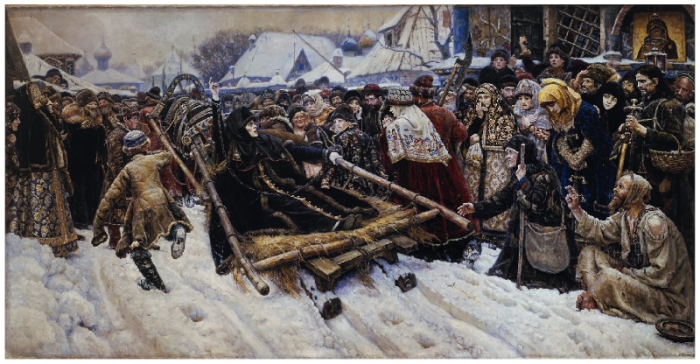
Within the Russian Orthodox Church, there exists a group known as the Old Believers, Old Ritualists, or Staroobryadtsy (старообрядцы), who are Eastern Orthodox Christians committed to preserving the liturgical and ritual traditions of the Apostolic Church as they existed prior to the Greek-influenced reforms, often referred to as the "raskol" (раскол), which took place between 1652 and 1666 in Russia.
 This pivotal event was instigated by serveral factors. Patriarch Nikon received substantial support from Tsar Aleksei for the reform. The Old Believers staunchly opposed these reforms, rooted in Greek Orthodox worship, and as a result, they faced anathematization, persecution, torture, and death for their unwavering faith. Protopriest Avvakum emerged as a prominent figure at the forefront of this resistance.
In contrast, the New Ritualists, also known as the New-Rite adherents, undertook a campaign to cleanse the church of elements they considered "incorrect" according to Greek and New-Rite Church reformed standards. This endeavor involved the destruction of books, worship traditions, and chants that deviated from western norms. The new church embraced rituals heavily influenced by Jesuit Western traditions, including multi-choral singing, ceremonial procedures, and symbolic traditions related to the Holy Eucharist, resulting in a liturgy that bore more resemblance to Catholicism than traditional Eastern Orthodoxy.
Apostolic Succession
 The Orthodox Church began on the day of Pentecost, when the Holy Spirit came down on the Apostles (Acts 2). This moment was not only the birth of the Church—it was also when the Apostles were given the grace and authority to lead it. From that point on, they began passing down this authority through the Mystery of Ordination, making new bishops to continue their work. One of these Apostles, Andrew the First-Called, preached the Gospel to the Greeks and traveled to Rus, present day Ukraine. The Church he helped plant, continues today through an unbroken line of bishops, which we call Apostolic Succession.
When Russia accepted the Orthodox faith from the Greeks, it received more than just prayers and teachings—it received the same Apostolic Succession from the line of Saint Andrew. That same line continues in our bishops today. Like baptism, ordination is never repeated... take a moment and reflect on this. Its like baptism, once the grace is given, it's forever. Even though the Church has faced challenges, changes, and persecution over the centuries, no heresy has ever broken this line or overcome the grace given by the Holy Spirit. The OldRite Church preserves a living connection to the early Church, remaining faithful to the traditions handed down from the very beginning. Because of this unbroken continuity, we are able to receive priests from the New-Rite. However, if a priest has been defrocked, he cannot and should not be accepted into another hierarchy.
The Sign of the Cross
 In Faith the OldRite tradition this is a Visible Confession of , the two-fingered sign of the cross is not merely a ritual gesture—it is a profound confession of faith, preserved from the earliest centuries of the Church. This ancient practice, using the index and middle fingers extended together, symbolizes the dual nature of Jesus Christ: fully God and fully man. It was the way saints, martyrs, and the faithful of Holy Rus blessed themselves for centuries.
For the unlearned common people of 17th-century Russia, the most visible and shocking change introduced during the Nikonian reforms was the forced transition from this two-fingered sign to the new three-fingered form, meant to align with Greek usage. This alteration struck at the heart of their daily spiritual life and was seen as a break from the faith of their fathers.
What many of these faithful were unaware of, however, was that this change was only the surface. Far more sweeping reforms were being introduced in the liturgical service books, the rites, and the structure of worship itself—changes that redefined the theological and spiritual life of the Church. The Old Believers rejected these innovations, holding fast to the two-fingered sign of the cross as a sacred inheritance—a visible marker of continuity with the Apostolic Church and ancient Orthodox tradition.
Time of Troubles

The Time of Troubles in Russia, spanning from 1598 to 1613, was a period of intense political turmoil, war, and violent dynastic transition. This era was marked by several key factors: the end of the Rurik dynasty, which led to a succession crisis; foreign intervention by Poland and Sweden; peasant uprisings; and the emergence of multiple pretenders to the throne. The famine of 1601-1603 exacerbated the situation, killing nearly a third of the population. The Polish-Lithuanian Commonwealth occupied parts of Russia, including Moscow, while Sweden seized territories in the north. These events culminated in widespread social unrest, lawlessness, and the near-collapse of the Russian state. The Time of Troubles finally ended with the election of Michael Romanov as tsar in 1613, establishing the Romanov dynasty that would rule Russia until 1917.
Currently
 From a historical perspective, the New-Rite church's efforts to create unity have had limited success, leading them to pursue alternative strategies. Current strategies have included converting less educated Priests, crafting narratives that do not align with historical facts, and leveraging political influence to implement their narratives. The movement's origins can be traced back to the 17th century when Patriarch Nikon introduced liturgical reforms in the Russian Orthodox Church, leading to a schism and the formation of the Old Believers. In more recent times, similar tactics have been employed by various religious movements in the United States, where groups like the Christian right have mobilized grassroots activism and formed alliances with political parties to advance their agendas. These methods have often involved reinterpreting historical events and religious doctrines to suit thier goals. Case and point the National Affairs Briefing Conference in 1980, which helped cement evangelical Christians as a reliable conservative voting bloc.
The practice of accepting converts as laymen under the pretense of being the true church is a contentious issue that stems from the deep-rooted schism between the Old Believers and the Russian Orthodox Church. This dispute has its origins in the 17th century when Patriarch Nikon introduced reforms to align Russian traditions with those of the Greek Orthodox Church. The Old Believers, who rejected these reforms, maintain that they are preserving the authentic traditions of the early church. They believe that the pre-reform rites are the true representation of Orthodox Christianity, as introduced to the Rus' in 988. From their perspective, the reforms introduced by Nikon were heretical deviations from the original faith. On the other hand, the New-Rite reformed church, views the Old Believers as schismatics. The church officially regarded the Old Believers as heretical by mainstream Orthodox standards for over 300 years. This led to persecution and isolation of Old Believer communities, forcing them to establish tight-knit, isolated groups to preserve their traditions.
Old Believers view themselves as the guardians of true Orthodoxy and may accept converts as laymen, believing they are bringing them into the authentic church. The Russian Orthodox Church, having implemented the reforms, considers itself the legitimate continuation of the Orthodox tradition and may view the Old Believers' practice of accepting converts as misleading.
This ongoing dispute reflects the complex history of Russian Orthodoxy and the deep-seated differences in interpretation of what constitutes authentic Orthodox practice. It's worth noting that in 1971, the Russian Orthodox Church abolished the anathema on the old rites, opening the door for potential reconciliation. However, most Old Believers have chosen not to rejoin, maintaining their belief in the authenticity. From a historical perspective, the New-Rite Church has had limited success in fostering unity within the broader religious community, as its approach has often involved alternative methods that have been controversial. The church has been criticized for recruiting uneducated Priests, which some argue undermines theological and spiritual rigor. Additionally, they create false narratives to shape its doctrines and traditions.
For a New-Rite narrative, refer to the Wikipedia page on this subject.